


It has been some time since I last wrote, but today I feel moved to share something close to my heart, which is what I have learned from reading the works of Allahyarham Prof. Al Attas.
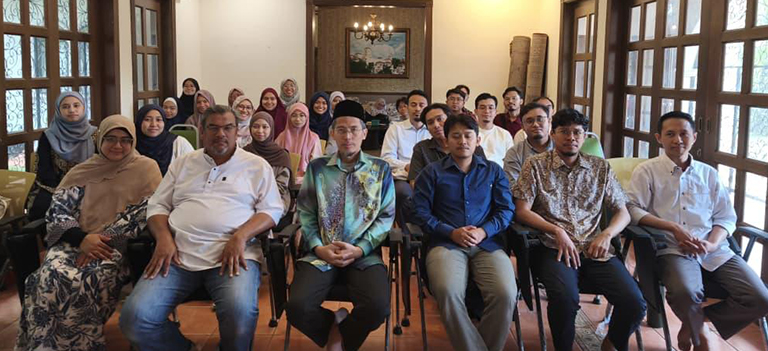
I should say from the beginning that I am not his student, nor even the formal student of his students. My path has been more modest. I have only joined a few events organized by CASIS, UTM, such as the Saturday Night Lectures and Assoc. Prof. Dr. Khalif’s class on Al-Ghazali’s works, which I have been attending twice a month for about six months now. Even with that limited exposure, something in those gatherings stirred me. The atmosphere, the respect for knowledge, and the seriousness of the discussions all left a deep impression. This was something I could not find in other academic events I used to attend. It felt different
By reading their books and joining intellectual gatherings, a window opened for me. They were not just books but invitations to think more deeply about faith, knowledge, and the world we live in. I may not have had the privilege of being a direct student, but through these writings and gatherings, I feel guided to see things with new clarity.
Of course, loving to read does not guarantee understanding of such works. I made a mistake once when I first tried to read a book by one of the CASIS students, Al-Ghazālī and Academic Excellence: The Art of Soul-Based Learning by Hasanul Arifin. I read it quickly, as I usually do, and ended up understanding nothing in the first few chapters. Only later did I learn that with books of this nature, one must read carefully and patiently. With that approach, comprehension and reflection gradually improve, and the content begins to reveal its depth.
I know very well that I am not able to give comments on such a great work by Prof. Al Attas. It is beyond my ability, with my limited sources and knowledge of the wider body of scholarship. Still, I feel moved to share what I have learned from reading his books, along with those written by his students, and how these readings connect to my academic work.
1. Knowledge comes from Allah, not just from our brains
This means that while we use our minds to think, study, and analyze, the true source of knowledge is Allah. Our brains are tools, but they are limited. Real wisdom and understanding come when Allah allows us to see the truth. This helps us stay humble, because no matter how smart or educated we are, we must always turn to Allah for guidance and clarity.
2. The need to understand the meaning of terms
Words are not just labels. They carry values, history, and context. If we use terms carelessly, we may misunderstand the ideas behind them. For example, in academic work, a single word can change the meaning of a whole argument. Prof. Al Attas stresses that defining terms correctly is the foundation of sound knowledge. Without this, confusion spreads, and knowledge loses its direction.
3. Practicing sabr (patience) in learning and writing
Learning is not instant. It requires time, effort, and patience. Writing, too, is a process of drafting, revising, and refining. Sabr means accepting that growth is gradual. It teaches us to stay calm when progress feels slow, and to trust that steady effort will bear fruit. In fact, patience itself is part of the learning. It shapes our character and makes our knowledge more meaningful.
4. Source, sourcing, and sources
These three words remind us to be careful about where our knowledge comes from. A source is the origin of information. Sourcing is the act of verifying the origin. Sources are the references we rely on to support our work. In academic life, this discipline ensures honesty and reliability. It also protects us from spreading false or weak ideas. By respecting sources, we respect the truth.
In the end, I don’t know what Allah wants to show me, from blindly buying random books to slowly delving into Prof. Al Attas’ works, and never failing to appreciate them. What I do know is that this journey has softened my heart and opened my eyes. It has taught me that knowledge is not just about intellect, but about humility before Allah, patience in the process, and respect for truth. Even with my small steps and limited understanding, I feel guided to see things with new clarity. For me, this is not only about academic growth, but also about drawing closer to Allah through the pursuit of knowledge.