


*This post summarizes the paper titled ‘The Development Direction and Challenges of STEM Integration: A Systematic Literature Review’. Click here to read: DOI
Think back to school.
Math was one class.
Science was another.
Technology, if you had it, felt like something separate again.
Everything was divided.
You learned formulas in one room.
Concepts in another.
And somehow, you were expected to connect them on your own.
But here is the truth.
The real world does not work like that.
The World Is Not Divided Like a Classroom
In real life, problems do not come labeled as “math” or “science.”
When engineers build a bridge, they use physics, mathematics, design, and technology all at once.
When doctors treat patients, they combine biology, data, and human understanding.
When we face global challenges, we do not solve them with one subject.
We solve them by connecting everything.
And yet, our education system still teaches students as if knowledge lives in separate boxes.
A Quiet Shift Is Already Happening
Across the world, educators are starting to rethink this.
Instead of teaching subjects one by one, they are moving towards something called STEM.
It sounds simple
Science, Technology, Engineering, Mathematics.
But the real idea is deeper than that.
It is not about adding more subjects.
It is about connecting them.
Learning Through Real Problems
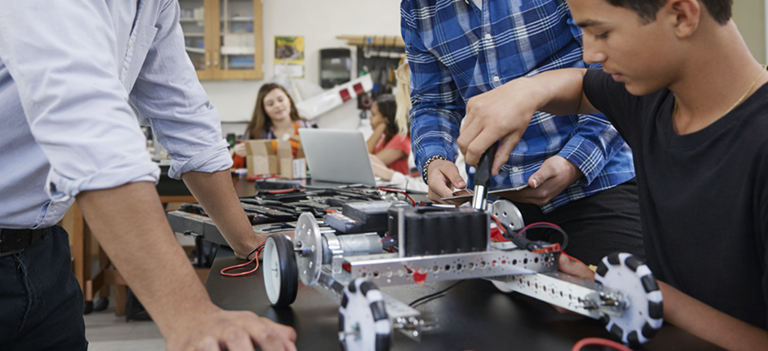
Imagine a classroom where students are not just listening.
Instead, they are building something.
A robot.
A small vehicle.
A smart solution to a real problem.
To do that, they must use math, science, and technology together.
Not separately.
This is what modern learning is starting to look like
learning through projects, through questions, through real situations.
From Teacher Talking to Students Doing
There is another big change happening.
In the past, learning was mostly about listening.
The teacher speaks.
Students take notes.
Exams decide everything.
But now, the focus is shifting.
Students are expected to explore, build, test, and think.
They learn by doing.
They ask questions.
They try.
They fail.
They try again.
And in that process, they learn more deeply than before.
But It Is Not As Easy As It Sounds
This shift is powerful, but it is not simple.
Teachers must now work across subjects.
Schools must redesign their lessons.
Students must adapt to a new way of learning.
Even time and resources become challenges.
In fact, one of the biggest difficulties is this
how do you connect subjects smoothly without losing depth?
How do you teach everything together
without confusing students?
These are real questions that educators are still trying to answer.
Why This Change Matters
Because the world has changed.
Technology is moving fast.
Jobs are changing.
Problems are becoming more complex.
Students today are not just preparing for exams.
They are preparing for a future we cannot fully predict.
And that future will not reward those who only know one thing.
It will reward those who can connect ideas
solve problems
and think across boundaries.
A Bigger Meaning Behind It All
At its core, this is not just about education.
It is about how we see knowledge.
Do we see it as separate pieces
or as something connected?
Because once students start seeing connections
they do not just memorize.
They understand.
Final Thought
Maybe the question is no longer
“What subject are you learning today?”
Maybe the better question is
“What problem are you solving today?”
Because in the end
learning is not about subjects.
It is about making sense of the world.
And the world has never been divided to begin with.