


…if we don’t know how to utilize it.
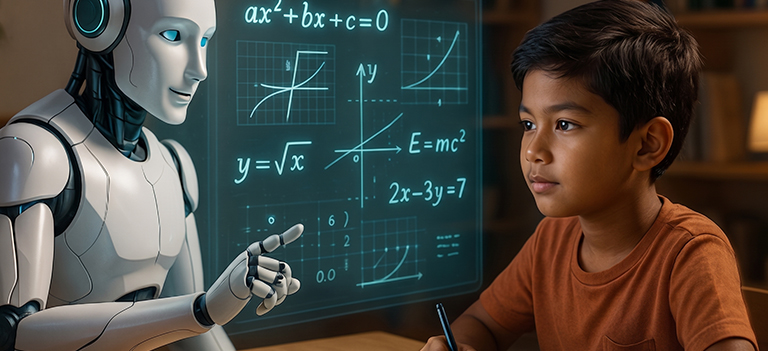
We have been mesmerized by the capabilities of AI. It can answer almost any question we ask, explain complex concepts within seconds, generate ideas, write essays, solve mathematical problems, and even give us advice.
The problem is not that AI can provide answers.
The problem is that we are becoming too comfortable with accepting those answers.
We are entering an era where children may begin to trust technology more than they trust their teachers. Not necessarily because AI is always more accurate, but because it is always available, responds instantly, and presents its answers with remarkable confidence.
A child asks AI a simple question about mathematics, science, history, or language and receives an answer within seconds. The answer may even be correct. The next time the child has a question, they ask AI again. And again. Over time, a habit is formed.
Question → AI → Answer.
There is nothing inherently wrong with this process.
***
The danger begins when the child stops asking:
“How did we get to this answer?”
and only asks:
“What is the answer?”
That is where education begins to face a serious challenge.
Education is not merely about transferring knowledge from a teacher to a student. It is about developing the ability to question, analyse, evaluate, reason, make decisions, and solve problems independently.
If students increasingly rely on AI to do the thinking for them, we may produce a generation that is highly capable of accessing information but increasingly incapable of thinking through information.
And this problem does not stop at the classroom.
Today, a student might ask AI to solve a mathematics problem.
Tomorrow, they might ask AI to write an assignment.
Later, they might ask AI which career they should choose.
Eventually, they may even ask AI how they should make decisions about their relationships, finances, careers, or life (possible? Yes!).
***
The concern is not that people will use AI for these things.
The concern is when people no longer know how to think and make decisions without AI.
If we allow this dependency to grow unchecked, we risk creating individuals who are technologically sophisticated but intellectually dependent.
They know how to use AI.
But they don’t know how to think without it.
This is why I don’t believe AI, by itself, will improve education.
***
AI will only improve education if we know how to educate people to use AI.
We need to teach students that AI is a tool, not an authority.
It can suggest.
It can explain.
It can challenge our ideas.
It can help us explore possibilities.
But it should not replace our ability to question, reason, and decide.
***
Perhaps the role of teachers in the AI era is therefore more important than ever.
Teachers should not compete with AI in providing answers. AI will almost certainly be faster.
Instead, teachers should teach students how to question the answers.
“Why is this answer correct?”
“What evidence supports it?”
“Could AI be wrong?”
“What assumptions did AI make?”
“What would happen if we approached the problem differently?”
These questions may become more important than the answers themselves.
And perhaps this is the real challenge of AI in education.
***
We need to spend more time thinking about what AI should do and, more importantly, what humans should continue to do for themselves.
Because the greatest danger of AI in education may not be that students become less knowledgeable.
It may be that they become less curious.
Less critical.
Less independent.
Less willing to struggle through a difficult problem.
And ultimately, less capable of thinking for themselves.
The question we should be asking is not:
“How can AI make our students smarter?”
Perhaps we should be asking:
“How can we use AI without making our students stop thinking?”
And this brings us to a much bigger question.
***
Is this simply what happens when we build technology faster than we build the wisdom to use it?
We build AI.
We adapt to it.
We advance it.
And only later do ethics, guidelines, governance, and responsibility come into the conversation (morality?).
Perhaps we should reverse the order.
Before we ask how far AI can go, we should ask how far we, as humans, should let it go.
Now, we are developing AI to imitate human thinking.
Later, will we humans become the robots who no longer know how to think for ourselves?
Is this really what we want?
That is something worth pondering.