Category: Blog

Your blog category

  • Humbled by Knowledge, Drawn to Faith: What I Owe to Prof. Al Attas’ Works

    Humbled by Knowledge, Drawn to Faith: What I Owe to Prof. Al Attas’ Works

    It has been some time since I last wrote, but today I feel moved to share something close to my heart, which is what I have learned from reading the works of Allahyarham Prof. Al Attas.

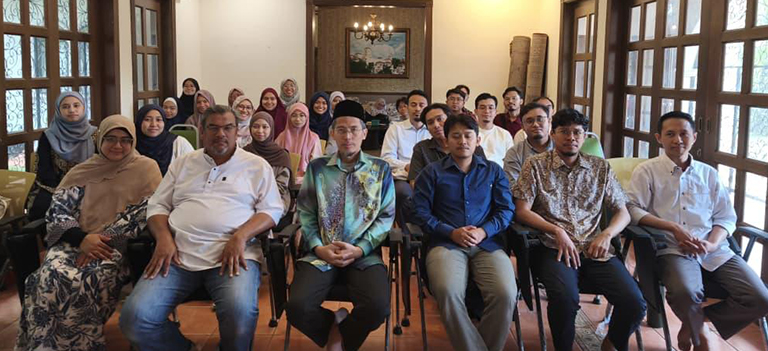
    I should say from the beginning that I am not his student, nor even the student of his students. My path has been more modest. I have only joined a few events organized by CASIS, UTM, such as the Saturday Night Lectures and Assoc. Prof. Dr. Khalif’s class on Al-Ghazali’s works, which I have been attending twice a month for about six months now. Even with that limited exposure, something in those gatherings stirred me. The atmosphere, the respect for knowledge, and the seriousness of the discussions all left a deep impression. This was something I could not find in other academic events I used to attend. It felt different

    By reading their books and joining intellectual gatherings, a window opened for me. They were not just books but invitations to think more deeply about faith, knowledge, and the world we live in. I may not have had the privilege of being a direct student, but through these writings and gatherings, I feel guided to see things with new clarity.

    Of course, loving to read does not guarantee understanding of such works. I made a mistake once when I first tried to read a book by one of the CASIS students, Al-Ghazālī and Academic Excellence: The Art of Soul-Based Learning by Hasanul Arifin. I read it quickly, as I usually do, and ended up understanding nothing in the first few chapters. Only later did I learn that with books of this nature, one must read carefully and patiently. With that approach, comprehension and reflection gradually improve, and the content begins to reveal its depth.

    I know very well that I am not able to give comments on such a great work by Prof. Al Attas. It is beyond my ability, with my limited sources and knowledge of the wider body of scholarship. Still, I feel moved to share what I have learned from reading his books, along with those written by his students, and how these readings connect to my academic work.

    1. Knowledge comes from Allah, not just from our brains

    This means that while we use our minds to think, study, and analyze, the true source of knowledge is Allah. Our brains are tools, but they are limited. Real wisdom and understanding come when Allah allows us to see the truth. This helps us stay humble, because no matter how smart or educated we are, we must always turn to Allah for guidance and clarity.

    2. The need to understand the meaning of terms

    Words are not just labels. They carry values, history, and context. If we use terms carelessly, we may misunderstand the ideas behind them. For example, in academic work, a single word can change the meaning of a whole argument. Prof. Al Attas stresses that defining terms correctly is the foundation of sound knowledge. Without this, confusion spreads, and knowledge loses its direction.

    3. Practicing sabr (patience) in learning and writing

    Learning is not instant. It requires time, effort, and patience. Writing, too, is a process of drafting, revising, and refining. Sabr means accepting that growth is gradual. It teaches us to stay calm when progress feels slow, and to trust that steady effort will bear fruit. In fact, patience itself is part of the learning. It shapes our character and makes our knowledge more meaningful.

    4. Source, sourcing, and sources

    These three words remind us to be careful about where our knowledge comes from. A source is the origin of information. Sourcing is the act of verifying the origin. Sources are the references we rely on to support our work. In academic life, this discipline ensures honesty and reliability. It also protects us from spreading false or weak ideas. By respecting sources, we respect the truth.

    In the end, I don’t know what Allah wants to show me, from blindly buying random books to slowly delving into Prof. Al Attas’ works, and never failing to appreciate them. What I do know is that this journey has softened my heart and opened my eyes. It has taught me that knowledge is not just about intellect, but about humility before Allah, patience in the process, and respect for truth. Even with my small steps and limited understanding, I feel guided to see things with new clarity. For me, this is not only about academic growth, but also about drawing closer to Allah through the pursuit of knowledge.

  • Blending Faith and Tech: Can Tech Support Spiritual Habits?

    Blending Faith and Tech: Can Tech Support Spiritual Habits?

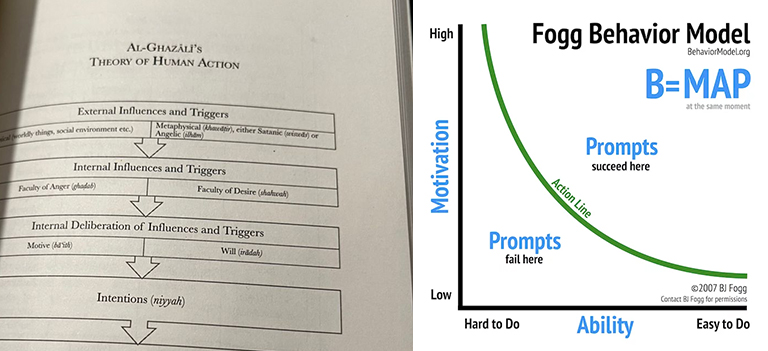
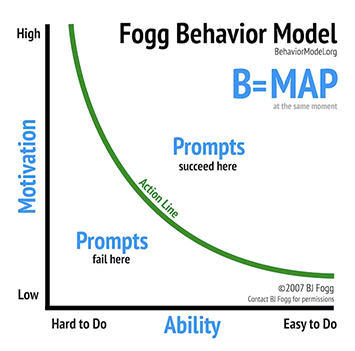
    Today has been quite busy writing a research proposal that needs to be submitted next week. While going through my old proposals, I came across one submitted last year. In short, this proposal attempted to integrate a behavior change model and a persuasive design model into “context-aware” technological features to encourage congregational prayer. It was my first attempt at exploring the religious domain.

    The reviewer’s comments on this proposal were quite interesting and raised many new questions. The emergence of these questions is not necessarily a bad thing, on the contrary, it is a blessing for a researcher.

    One of the comments stated:

    “The researcher should seek advice from religious scholars. Can this method be used? To what extent can it be applied? In my view, the act of performing prayer stems from faith (iman). If faith is weak, one will forget. If faith is strong, no matter how busy, one will prioritize it. Is the context aware and persuasive method appropriate in this case?”

    This comment indeed has a valid basis.

    The suitability of behavior change frameworks or any other theories of a secular nature that separate religious, spiritual, and metaphysical elements is questionable when implemented in technology aimed at encouraging religious practices of a spiritual nature, such as prayer.

    There are already research domains and concepts that attempt to integrate technology with religion, such as “Digital Religion” and “Technomoral.” Several Western universities have even established dedicated research centers for this domain:https://www.technomoralfutures.uk/

    Much work and research have been conducted there on the philosophy of technology and ethics. However, when discussing philosophy and ethics, these areas are closely tied to worldviews. Naturally, studies applying a Western secular worldview will be framed as “universal” and referenced by subsequent researchers.

    But what about Islam?

    Returning to that proposal, several questions arise:

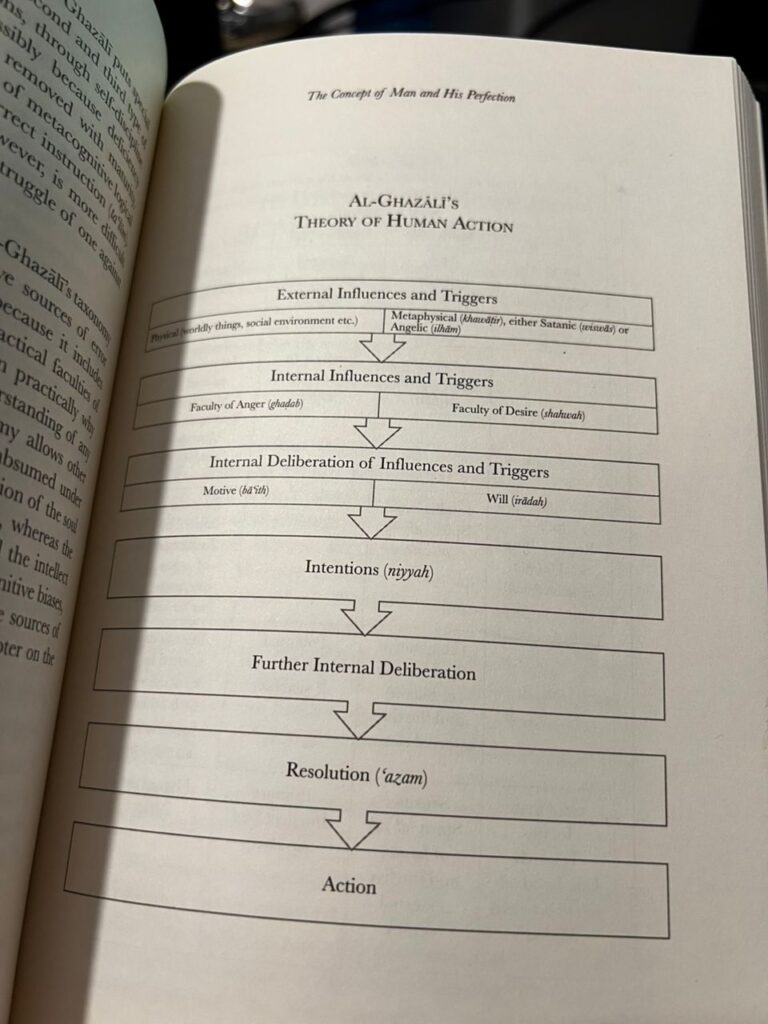
    • How can behavior change frameworks or other theories based on religion, such as Al Ghazali’s Theory of Human Action, which involves spiritual and metaphysical elements, be translated into technology design?

    In the Islamic context, integrating technology into the religious domain requires deep scrutiny because it involves matters of Islamic rulings (ahkam), spirituality, and metaphysics, not merely outward actions. One possible approach at this early stage is to develop a technology design framework grounded in the Quran and Hadith, aligned with the maqasid al shariah. For example, the Hadith in which the Prophet ﷺ advised that when visiting someone’s home, one should greet (give salam) and ask permission up to three times; if permission is not granted to enter, one should leave. Could such a hadith on visitation etiquette be translated into a notification feature, for instance? (Of course, this would require consultation with religious scholars and experts.)

    If such a framework could be translated into technological features, another question arises:

    • How, and with what indicators, can we measure the effectiveness of such technology in strengthening spiritually oriented practices according to the religious understanding?

    In research, determining these success or effectiveness indicators is crucial for assessing whether the hypothesis has been achieved. This is especially true in technical fields such as information technology, where research typically emphasizes empirical evidence. Yet no technology can measure sin, reward (pahala), sincerity, and so on.

    If spiritual and metaphysical indicators are excluded, then how would Islamic technology differ from other secular technologies? Does the concept of Islamization of technology exist?

    Answering these questions requires exploring and engaging with many other branches of knowledge, including religious sciences such as tafsir, hadith, and fiqh, as well as fields like the philosophy of Islamic science and epistemology, to explore the Islamic worldview and thought framework.

    References:

  • Finding Motivation to Become a Successful Ph.D Student

    Finding Motivation to Become a Successful Ph.D Student

    This sample post is generated by A.I

    Embarking on a Ph.D journey is an exciting and challenging endeavor. It requires dedication, perseverance, and a strong sense of motivation. Whether you are just starting your Ph.D program or are in the midst of it, finding and maintaining motivation is crucial for your success.

    One of the key factors in staying motivated is having a clear vision of your goals. Take some time to reflect on why you chose to pursue a Ph.D in the first place. Is it the desire for knowledge, the opportunity to make a meaningful contribution to your field, or the chance to become an expert in your area of interest? Remind yourself of these reasons regularly to reignite your motivation.

    Another effective way to stay motivated is to surround yourself with a supportive network. Connect with fellow Ph.D students, join study groups, or seek guidance from your professors. Sharing your struggles and triumphs with others who understand the challenges of a Ph.D program can provide valuable encouragement and motivation.

    Setting realistic and achievable goals can also help you maintain motivation throughout your Ph.D journey. Break down your research or coursework into smaller tasks, and celebrate each milestone you achieve. By focusing on these smaller victories, you will stay motivated and avoid feeling overwhelmed by the enormity of the entire Ph.D process.

    Additionally, make sure to take care of yourself physically and mentally. Prioritize self-care activities such as exercise, proper nutrition, and sufficient sleep. Engage in hobbies or activities that bring you joy and relaxation. Keeping a healthy work-life balance will prevent burnout and help you stay motivated in the long run.

    Lastly, remember to celebrate your progress and accomplishments along the way. Acknowledge the hard work and dedication you have put into your Ph.D program. Treat yourself to small rewards or celebrate with loved ones when you achieve significant milestones. Recognizing your achievements will boost your motivation and reinforce your belief in your ability to succeed.

    While the Ph.D journey can be challenging, finding and maintaining motivation will help you overcome obstacles and achieve success. By staying focused on your goals, building a support network, setting achievable milestones, taking care of yourself, and celebrating your progress, you will be on your way to becoming a successful Ph.D student.