


*This post summarizes the paper titled ‘Immersive Tai Chi for Home-Based Exercise in Older Adults: Usability and Feasibility Study’. Click here to read: DOI
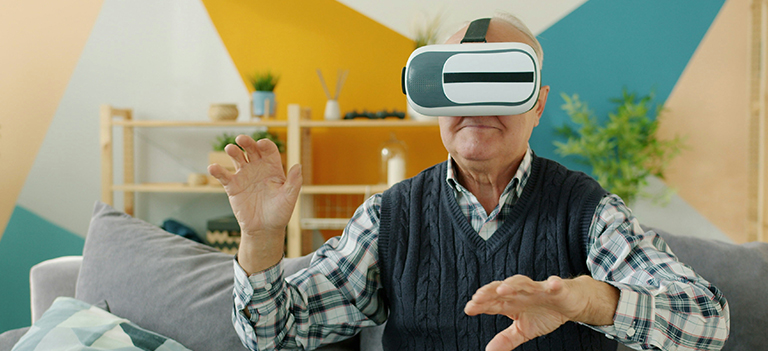
Imagine this.
You are in your living room. No gym. No instructor. No crowd.
Just you… and a headset.
Suddenly, the space around you transforms. A calm landscape appears. Gentle music plays. A figure shows you how to move. You follow, slowly, deliberately. Your hands rise, your body flows.
You are doing Tai Chi.
But not in a park. Not in a class.
Inside a virtual world.
This is no longer science fiction. It is already happening.
A recent study explored whether older adults could actually use virtual reality to exercise at home. Not just for fun, but as a real tool to stay healthy, independent, and active as they age.
The Problem We Rarely Talk About
We know exercise is important, especially for older adults. It keeps the body strong, the mind sharp, and reduces the risk of falling.
But here is the reality.
Many older adults do not stick to exercise routines.
Why?
Because it is not always easy.
There is fear of falling. Lack of motivation. Limited access to facilities. Sometimes, just the feeling that it is not enjoyable.
Traditional exercise, for many, simply does not fit their daily lives anymore.
A Different Kind of Exercise
So researchers tried something different.
They combined Tai Chi, a gentle and proven form of movement, with virtual reality and mixed reality technology.
The idea was simple:
What if exercise could feel like a game?
Participants wore headsets and followed guided movements inside a virtual environment. The system tracked their hands and body, gave feedback, and turned each session into a kind of interactive experience.
Short sessions. Just five minutes each.
Simple movements. Repeated with guidance.
All designed to be done at home.
What Happened Next Was Interesting
Most participants did not just accept the system.
They actually enjoyed it.
They reported feeling:
- Happy
- Engaged
- Capable
In fact, their sense of “competence” and enjoyment was surprisingly high, while feelings of stress or frustration were very low.
Even more interesting, many said the activity did not feel difficult at all.
That may sound like a small detail, but it matters.
Because when something feels easy and enjoyable, people are far more likely to continue doing it.
But Not Everyone Could Use It
Here is where the story becomes more complex.
Not everyone could adapt to virtual reality.
About 1 in 5 participants dropped out early because they felt dizzy or uncomfortable.
Even among those who continued, some still experienced mild symptoms like:
- Dizziness
- Eye strain
- A slight sense of imbalance
This is what researchers call “cybersickness.”
So while the idea is promising, the technology is not yet perfect.
A Curious Paradox
There was another surprising finding.
Participants felt confident.
They believed they were doing well.
But in reality, their movement accuracy was only moderate.
This creates what researchers describe as a kind of paradox:
People feel capable, even when their performance is not perfect.
And strangely, that might not be a bad thing.
Because that feeling of success encourages them to keep going.
In the long run, consistency may matter more than perfection.
What This Means for the Future
This study is not just about technology.
It is about how we rethink aging.
For decades, we have treated exercise as something structured, formal, sometimes even intimidating.
But what if it could be:
- Personal
- Flexible
- Enjoyable
- Done at home
Virtual reality opens that possibility.
It turns exercise into an experience, not a task.
But there is still work to do.
The technology must become more comfortable.
More accessible.
More intuitive.
And most importantly, it must work not just for the active elderly, but for everyone.
The Bigger Question
This raises a deeper question.
As technology becomes more embedded in our lives,
will it replace traditional ways of staying healthy?
Or will it simply become another tool, one that adapts to us instead of forcing us to adapt to it?
Perhaps the answer lies somewhere in between.
Final Thought
In the end, this is not just a story about Tai Chi or virtual reality.
It is about dignity.
About giving people the ability to stay active, independent, and confident, even as they grow older.
And if a headset and a virtual world can help achieve that,
then maybe the future of aging is not something to fear.
But something we can redesign.