Author: mhdhidir.com

  • Why must HCI practitioners/researchers be aware of AI?
    Why must HCI practitioners/researchers be aware of AI?

    Why must HCI practitioners/researchers be aware of AI?

    This is an important question because, apart from accommodating AI requirements and contributing to its advancement. By observing the widespread implementation of AI across various sectors in today’s world, including both the public and private sectors, it is evident that the traditional way of approaching HCI needs to evolve more rapidly. This shift is necessary to account for the impact of AI on the overall user experience in technology.

    AI, from the perspective of an HCI practitioner, is not about the technical processes that make the technology more intelligent or the hardware that makes it more efficient. Those aspects are the domain of AI experts. Instead, HCI practitioners need to focus on how AI technology affects users, particularly in terms of their thinking and decision-making processes, because there is no doubt that people will increasingly rely on AI to make decisions, from small everyday choices to major, important ones.

    To put this into context, every time a new technology is invented, apart from benefiting people in terms of the problems it solves, it can also affect them in negative ways. This is similar to when the calculator was invented. Although it helps people solve complex mathematical equations more quickly, it has also led to a reduced ability to perform mental arithmetic. As a result, people may become less confident or slower when calculating without the tool. The same applies to other technologies, such as GPS navigation systems and many others.

    The impact of AI is much bigger than tools like calculators or GPS. This is because AI is not only helping users to complete tasks, but it is also shaping how they think, decide, and interact with the world.

    Things to ponder,

    1. AI is now widely used in many sectors, including education at all levels. From primary school to university, students are exposed to AI tools in their daily learning activities. Over time, this makes the younger generation very familiar and comfortable with relying on AI. It slowly becomes part of their normal way of doing things, not just a tool they use occasionally.
    2. Because of this constant exposure, AI begins to influence how users decide what is right and wrong, or what is good and bad. When users frequently depend on AI for answers, suggestions, or feedback, they may start to trust it without questioning. This can shape their judgement, sometimes without them even realizing it.
    3. The persuasive power of AI is increasing over time. As AI processes more data and learns from user interactions, it becomes better at giving responses that feel relevant, convincing, and personal. This makes users more likely to accept what the AI suggests. The more people use it, the more the system improves, and the stronger its influence becomes.
    4. This situation changes how we understand user experience. HCI practitioners can no longer rely only on traditional methods to study user preferences. Users are no longer interacting with fixed systems. They are interacting with systems that learn, adapt, and evolve. To truly understand users today, and even more in the future, we must also understand how AI is shaping their behaviour and expectations over time.

    For those working in privacy and ethics, there is a growing responsibility to guide how AI should be designed and used. It is not enough to focus only on technical performance. There must be clear guidelines to ensure that AI supports users in a responsible way. This includes protecting user data, avoiding manipulation, and ensuring that AI systems act in ways that are aligned with human values.

    Human values? Then it leads to philosophical questions that require a deeper understanding… (continue in part 2)

  • Humbled by Knowledge, Drawn to Faith: What I Owe to Prof. Al Attas’ Works

    Humbled by Knowledge, Drawn to Faith: What I Owe to Prof. Al Attas’ Works

    It has been some time since I last wrote, but today I feel moved to share something close to my heart, which is what I have learned from reading the works of Allahyarham Prof. Al Attas.

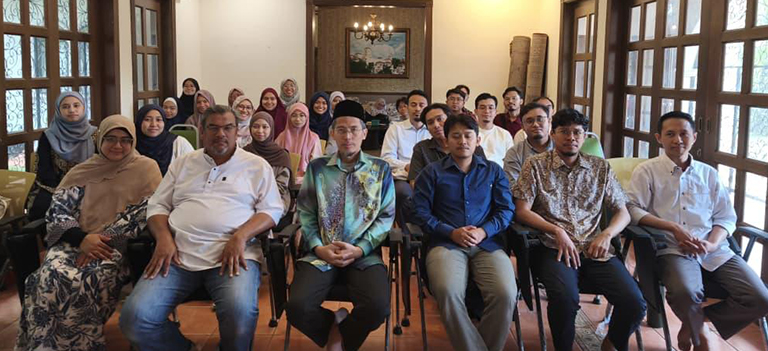
    I should say from the beginning that I am not his student, nor even the student of his students. My path has been more modest. I have only joined a few events organized by CASIS, UTM, such as the Saturday Night Lectures and Assoc. Prof. Dr. Khalif’s class on Al-Ghazali’s works, which I have been attending twice a month for about six months now. Even with that limited exposure, something in those gatherings stirred me. The atmosphere, the respect for knowledge, and the seriousness of the discussions all left a deep impression. This was something I could not find in other academic events I used to attend. It felt different

    By reading their books and joining intellectual gatherings, a window opened for me. They were not just books but invitations to think more deeply about faith, knowledge, and the world we live in. I may not have had the privilege of being a direct student, but through these writings and gatherings, I feel guided to see things with new clarity.

    Of course, loving to read does not guarantee understanding of such works. I made a mistake once when I first tried to read a book by one of the CASIS students, Al-Ghazālī and Academic Excellence: The Art of Soul-Based Learning by Hasanul Arifin. I read it quickly, as I usually do, and ended up understanding nothing in the first few chapters. Only later did I learn that with books of this nature, one must read carefully and patiently. With that approach, comprehension and reflection gradually improve, and the content begins to reveal its depth.

    I know very well that I am not able to give comments on such a great work by Prof. Al Attas. It is beyond my ability, with my limited sources and knowledge of the wider body of scholarship. Still, I feel moved to share what I have learned from reading his books, along with those written by his students, and how these readings connect to my academic work.

    1. Knowledge comes from Allah, not just from our brains

    This means that while we use our minds to think, study, and analyze, the true source of knowledge is Allah. Our brains are tools, but they are limited. Real wisdom and understanding come when Allah allows us to see the truth. This helps us stay humble, because no matter how smart or educated we are, we must always turn to Allah for guidance and clarity.

    2. The need to understand the meaning of terms

    Words are not just labels. They carry values, history, and context. If we use terms carelessly, we may misunderstand the ideas behind them. For example, in academic work, a single word can change the meaning of a whole argument. Prof. Al Attas stresses that defining terms correctly is the foundation of sound knowledge. Without this, confusion spreads, and knowledge loses its direction.

    3. Practicing sabr (patience) in learning and writing

    Learning is not instant. It requires time, effort, and patience. Writing, too, is a process of drafting, revising, and refining. Sabr means accepting that growth is gradual. It teaches us to stay calm when progress feels slow, and to trust that steady effort will bear fruit. In fact, patience itself is part of the learning. It shapes our character and makes our knowledge more meaningful.

    4. Source, sourcing, and sources

    These three words remind us to be careful about where our knowledge comes from. A source is the origin of information. Sourcing is the act of verifying the origin. Sources are the references we rely on to support our work. In academic life, this discipline ensures honesty and reliability. It also protects us from spreading false or weak ideas. By respecting sources, we respect the truth.

    In the end, I don’t know what Allah wants to show me, from blindly buying random books to slowly delving into Prof. Al Attas’ works, and never failing to appreciate them. What I do know is that this journey has softened my heart and opened my eyes. It has taught me that knowledge is not just about intellect, but about humility before Allah, patience in the process, and respect for truth. Even with my small steps and limited understanding, I feel guided to see things with new clarity. For me, this is not only about academic growth, but also about drawing closer to Allah through the pursuit of knowledge.

  • The Classroom Has Changed, So Has the Teacher

    The Classroom Has Changed, So Has the Teacher

    *This post summarizes the paper titled Innovative Teaching in the Digital Age: Exploring the Role of Teachers through Pre-Service Teachers’ Lenses.Click here to read: DOI

    There was a time when teaching was simple.

    A teacher walked into class, wrote on the board, explained, and students listened. That was enough.

    But today, everything has changed.

    Classrooms are no longer just rooms. They are screens, apps, videos, and digital spaces. Learning is no longer about just listening. It is about exploring, clicking, creating, and questioning. And in the middle of all this change, one question quietly appears.

    What is a teacher now?

    This study tried to answer that question. It listened to future teachers, those still in training, those who will soon step into real classrooms. What they said is simple, but powerful.

    They no longer see teachers as just people who deliver content.

    They see teachers as creators.

    Many of them said a teacher should design learning, not just present slides. A good lesson is not about showing information, but about building an experience. Something students can connect with, something that fits their level, their style, their pace.

    So teaching becomes something more alive. A teacher is like an architect, building learning step by step.

    But designing alone is not enough.

    The second thing they spoke about is skill. Not just any skill, but digital skill. In today’s world, knowing how to use technology is no longer optional. It is basic. Teachers must be confident using tools, platforms, and new systems. They must keep learning, because technology never stops moving.

    Yet here is the reality.

    Not every teacher has enough time. Not every school has strong internet. Not everyone gets proper training. So even if teachers want to innovate, sometimes the system holds them back.

    And that leads to the third idea.

    No teacher can do this alone.

    The future teachers spoke about sharing. Talking. Learning from each other. When teachers exchange ideas, things move faster. When they work together, they feel more confident to try new things.

    Innovation, in the end, is not an individual act. It is a shared journey.

    When you put all three together, a clearer picture appears.

    A modern teacher is someone who designs learning, understands technology, and works with others.

    Not separate roles, but one connected identity.

    And when these three meet, something powerful happens. Teaching becomes more creative, more meaningful, and more human.

    But there is one important truth behind all this.

    Technology itself is not the goal.

    It is just a tool.

    What matters is how teachers use it. Whether they use it to make learning more engaging, more thoughtful, and more relevant.

    That is where real teaching still lives.

    In the decisions teachers make every day.

    In the way they shape experiences for their students.

    In the way they continue learning, even as they teach.

    Because in the end, the role of a teacher has not disappeared.

    It has simply evolved.

    And the future teachers already understand this.

    They are not waiting to be told what to do.

    They are ready to build something new.

  • When Students Learn to Care Not Just Solve

    When Students Learn to Care Not Just Solve

    *This post summarizes the paper titled STEM with a Conscience: Exploring the Development of STEM Skills and Social Values among Malaysian StudentsClick here to read: DOI

    Imagine a classroom.

    Not one where students are quietly copying notes.
    Not one where the goal is just to pass an exam.

    But a classroom where a simple question is asked:

    “What problem do you want to solve for your country?”

    And suddenly, everything changes.

    It Starts With a Feeling

    At first, the answers are simple.

    “I want to stop bullying.”
    “I want to help poor people.”
    “I want to make life easier for others.”

    These answers come from the heart.
    They are full of care, but not yet clear on how.

    Students feel the problem.
    But they do not yet know how to solve it.

    Then Something Shifts

    After going through a STEM based learning program, something interesting happens.

    The same students begin to think differently.

    Not just with emotion
    but with ideas.

    Not just with care
    but with action.

    Instead of saying “I want to help flood victims,”
    they begin to say:

    “I want to design houses that can survive floods.”

    Instead of “reduce cost of living,”
    they say:

    “I want to create systems that lower electricity use.”

    Instead of “stop bullying,”
    they say:

    “I want to build an app to spread awareness and support victims.”

    From Feeling to Solving

    This is the real transformation.

    Students move from simply caring
    to actually creating solutions.

    They begin to connect knowledge with real life.

    Science is no longer just theory.
    Technology is no longer just tools.

    Both become ways to make life better.

    Learning Becomes More Than Just Knowledge

    What makes this powerful is not just the skills they learn.

    It is the values they develop.

    Students begin to think about:

    • fairness
    • responsibility
    • the environment
    • their role in society

    They start to see themselves not just as learners
    but as people who can contribute.

    People who can build.
    People who can change things.

    A Different Kind of Education

    This approach is often called learning with purpose.

    Instead of separating subjects,
    students work on real problems.

    They build, test, and improve ideas.

    They learn by doing.

    And in that process, they develop more than knowledge
    they develop character.

    Why This Matters Today

    The world today is more complex than ever.

    Floods. Rising costs. Social issues.
    These are not problems that can be solved by memorizing facts.

    They need people who can think
    connect ideas
    and care about others.

    And that is exactly what this kind of learning builds.

    A New Way to See Students

    This study shows something important.

    Students are not just future workers.

    They are future problem solvers.
    Future leaders.
    Future changemakers.

    But only if we teach them the right way.

    Final Thought

    Maybe education should not only ask:

    “What do you know?”

    Maybe it should also ask:

    “What will you do with what you know?”

    Because in the end
    knowledge alone is not enough.

    What truly matters
    is how we use it
    for others.

  • Why Schools Must Stop Teaching Subjects One by One

    Why Schools Must Stop Teaching Subjects One by One

    *This post summarizes the paper titled The Development Direction and Challenges of STEM Integration: A Systematic Literature ReviewClick here to read: DOI

    Think back to school.

    Math was one class.
    Science was another.
    Technology, if you had it, felt like something separate again.

    Everything was divided.

    You learned formulas in one room.
    Concepts in another.
    And somehow, you were expected to connect them on your own.

    But here is the truth.

    The real world does not work like that.

    The World Is Not Divided Like a Classroom

    In real life, problems do not come labeled as “math” or “science.”

    When engineers build a bridge, they use physics, mathematics, design, and technology all at once.
    When doctors treat patients, they combine biology, data, and human understanding.
    When we face global challenges, we do not solve them with one subject.

    We solve them by connecting everything.

    And yet, our education system still teaches students as if knowledge lives in separate boxes.

    A Quiet Shift Is Already Happening

    Across the world, educators are starting to rethink this.

    Instead of teaching subjects one by one, they are moving towards something called STEM.

    It sounds simple
    Science, Technology, Engineering, Mathematics.

    But the real idea is deeper than that.

    It is not about adding more subjects.
    It is about connecting them.

    Learning Through Real Problems

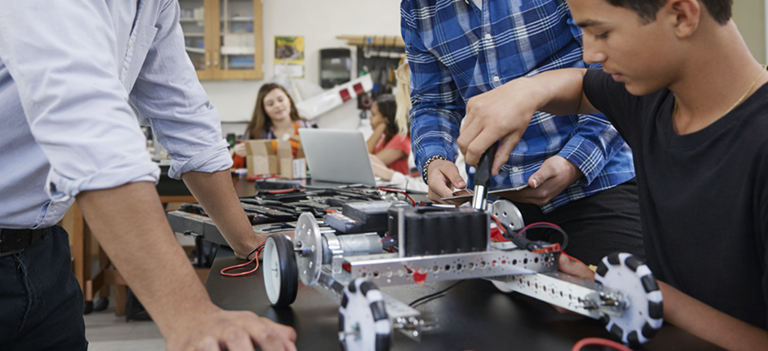
    Imagine a classroom where students are not just listening.

    Instead, they are building something.

    A robot.
    A small vehicle.
    A smart solution to a real problem.

    To do that, they must use math, science, and technology together.

    Not separately.

    This is what modern learning is starting to look like
    learning through projects, through questions, through real situations.

    From Teacher Talking to Students Doing

    There is another big change happening.

    In the past, learning was mostly about listening.

    The teacher speaks.
    Students take notes.
    Exams decide everything.

    But now, the focus is shifting.

    Students are expected to explore, build, test, and think.

    They learn by doing.

    They ask questions.
    They try.
    They fail.
    They try again.

    And in that process, they learn more deeply than before.

    But It Is Not As Easy As It Sounds

    This shift is powerful, but it is not simple.

    Teachers must now work across subjects.
    Schools must redesign their lessons.
    Students must adapt to a new way of learning.

    Even time and resources become challenges.

    In fact, one of the biggest difficulties is this
    how do you connect subjects smoothly without losing depth?

    How do you teach everything together
    without confusing students?

    These are real questions that educators are still trying to answer.

    Why This Change Matters

    Because the world has changed.

    Technology is moving fast.
    Jobs are changing.
    Problems are becoming more complex.

    Students today are not just preparing for exams.
    They are preparing for a future we cannot fully predict.

    And that future will not reward those who only know one thing.

    It will reward those who can connect ideas
    solve problems
    and think across boundaries.

    A Bigger Meaning Behind It All

    At its core, this is not just about education.

    It is about how we see knowledge.

    Do we see it as separate pieces
    or as something connected?

    Because once students start seeing connections
    they do not just memorize.

    They understand.

    Final Thought

    Maybe the question is no longer
    “What subject are you learning today?”

    Maybe the better question is
    “What problem are you solving today?”

    Because in the end
    learning is not about subjects.

    It is about making sense of the world.

    And the world has never been divided to begin with.

  • Why Big Images Make Learning Hard? Cause and Solution

    Why Big Images Make Learning Hard? Cause and Solution

    *This post summarizes the paper titled ‘Application of Singular Value Decomposition for Image Compression of Yogyakarta Cosmological Axis in Digital Learning in Vocational Education’. Click here to read: DOI

    Think about this.

    You open your phone to study something important.
    A picture loads… slowly. Then it freezes. Then it fails.

    You try again.

    Still the same.

    In a world where everything is digital, sometimes the biggest problem is something very simple
    files that are just too large.

    And this is not just a small issue. It affects how people learn.

    When Pictures Become a Problem

    In vocational learning, pictures are not just decoration.
    They are the lesson.

    Students need to see details. Shapes. Structures. Patterns.
    Without clear visuals, understanding becomes harder.

    But here is the challenge.

    High quality images are heavy.
    They take time to load. They use storage. They slow everything down.

    This becomes even more difficult when learning happens online, especially for students using basic devices or limited internet.

    So the real question becomes simple.

    How do we keep the image clear… but make it lighter?

    A Simple but Powerful Idea

    Researchers looked for a way to solve this.

    Not by removing the image.
    Not by reducing its importance.

    But by changing how the image is stored.

    They used a method called SVD.

    It sounds technical. But the idea is actually quite simple.

    Every image is made of information.
    But not all information is equally important.

    Some parts carry the main structure
    the shapes, the outlines, the meaning.

    Other parts are just small details
    tiny textures, minor noise.

    What if we keep only the most important parts…
    and let go of the rest?

    What Happens When You Keep Only What Matters

    When this method was applied, something interesting happened.

    Even after removing a lot of data,
    the image still looked almost the same.

    The main structure remained clear.
    The important details were still visible.

    This means the image became lighter
    but still useful for learning.

    In fact, the study showed that most of an image can be preserved using only a small portion of its original data.

    But There Is Always a Trade Off

    Of course, nothing comes for free.

    If you reduce too much, the image becomes blurry.
    Details disappear. The meaning starts to fade.

    If you keep more data, the image looks better
    but the file becomes heavier again.

    So the real task is not just compression.

    It is balance.

    Finding the point where the image is still clear enough
    but light enough to move easily.

    Why This Matters More Than We Think

    This is not just about images.

    This is about access.

    When files are lighter:

    • Students can learn faster
    • Materials can reach more people
    • Learning becomes more inclusive

    And when learning becomes easier to access,
    it becomes more powerful.

    Especially in vocational education, where seeing is understanding.

    A Bigger Picture

    There is also something deeper here.

    This method was applied to images of cultural heritage
    something meaningful, something worth preserving.

    And yet, even these detailed and rich images
    could be made lighter without losing their identity.

    It shows that technology does not have to erase meaning.

    It can protect it, while making it easier to share.

    Final Thought

    Sometimes, innovation is not about adding more.

    It is about removing what is not needed.

    Keeping what matters.
    Letting go of what does not.

    And in doing so, making something better
    simpler
    lighter
    and more accessible to everyone.

  • When Exercise Meets Virtual Worlds: Can Tai Chi in VR Change How We Age?

    When Exercise Meets Virtual Worlds: Can Tai Chi in VR Change How We Age?

    *This post summarizes the paper titled Immersive Tai Chi for Home-Based Exercise in Older Adults: Usability and Feasibility StudyClick here to read: DOI

    Imagine this.

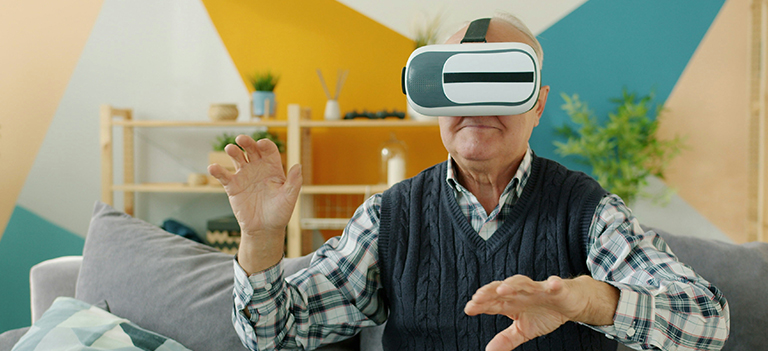
    You are in your living room. No gym. No instructor. No crowd.
    Just you… and a headset.

    Suddenly, the space around you transforms. A calm landscape appears. Gentle music plays. A figure shows you how to move. You follow, slowly, deliberately. Your hands rise, your body flows.

    You are doing Tai Chi.
    But not in a park. Not in a class.
    Inside a virtual world.

    This is no longer science fiction. It is already happening.

    A recent study explored whether older adults could actually use virtual reality to exercise at home. Not just for fun, but as a real tool to stay healthy, independent, and active as they age.

    The Problem We Rarely Talk About

    We know exercise is important, especially for older adults. It keeps the body strong, the mind sharp, and reduces the risk of falling.

    But here is the reality.

    Many older adults do not stick to exercise routines.

    Why?

    Because it is not always easy.
    There is fear of falling. Lack of motivation. Limited access to facilities. Sometimes, just the feeling that it is not enjoyable.

    Traditional exercise, for many, simply does not fit their daily lives anymore.

    A Different Kind of Exercise

    So researchers tried something different.

    They combined Tai Chi, a gentle and proven form of movement, with virtual reality and mixed reality technology.

    The idea was simple:
    What if exercise could feel like a game?

    Participants wore headsets and followed guided movements inside a virtual environment. The system tracked their hands and body, gave feedback, and turned each session into a kind of interactive experience.

    Short sessions. Just five minutes each.
    Simple movements. Repeated with guidance.
    All designed to be done at home.

    What Happened Next Was Interesting

    Most participants did not just accept the system.
    They actually enjoyed it.

    They reported feeling:

    • Happy
    • Engaged
    • Capable

    In fact, their sense of “competence” and enjoyment was surprisingly high, while feelings of stress or frustration were very low.

    Even more interesting, many said the activity did not feel difficult at all.

    That may sound like a small detail, but it matters.

    Because when something feels easy and enjoyable, people are far more likely to continue doing it.

    But Not Everyone Could Use It

    Here is where the story becomes more complex.

    Not everyone could adapt to virtual reality.

    About 1 in 5 participants dropped out early because they felt dizzy or uncomfortable.

    Even among those who continued, some still experienced mild symptoms like:

    • Dizziness
    • Eye strain
    • A slight sense of imbalance

    This is what researchers call “cybersickness.”

    So while the idea is promising, the technology is not yet perfect.

    A Curious Paradox

    There was another surprising finding.

    Participants felt confident.
    They believed they were doing well.

    But in reality, their movement accuracy was only moderate.

    This creates what researchers describe as a kind of paradox:

    People feel capable, even when their performance is not perfect.

    And strangely, that might not be a bad thing.

    Because that feeling of success encourages them to keep going.

    In the long run, consistency may matter more than perfection.

    What This Means for the Future

    This study is not just about technology.
    It is about how we rethink aging.

    For decades, we have treated exercise as something structured, formal, sometimes even intimidating.

    But what if it could be:

    • Personal
    • Flexible
    • Enjoyable
    • Done at home

    Virtual reality opens that possibility.

    It turns exercise into an experience, not a task.

    But there is still work to do.

    The technology must become more comfortable.
    More accessible.
    More intuitive.

    And most importantly, it must work not just for the active elderly, but for everyone.

    The Bigger Question

    This raises a deeper question.

    As technology becomes more embedded in our lives,
    will it replace traditional ways of staying healthy?

    Or will it simply become another tool, one that adapts to us instead of forcing us to adapt to it?

    Perhaps the answer lies somewhere in between.

    Final Thought

    In the end, this is not just a story about Tai Chi or virtual reality.

    It is about dignity.

    About giving people the ability to stay active, independent, and confident, even as they grow older.

    And if a headset and a virtual world can help achieve that,
    then maybe the future of aging is not something to fear.

    But something we can redesign.

  • When Students Can See Their Ideas Come Alive

    When Students Can See Their Ideas Come Alive

    *This post summarizes the paper titled Augmented Reality’s Impact on Student Creativity in Design and Technology: An Immersive Learning Study’. Click here to read: DOI

    It started like any other classroom.

    A group of students sat with their notebooks, trying to sketch ideas for a machine they had never seen in real life. Some stared at the paper. Others drew something simple and stopped. A few looked around, unsure of what to do next.

    This is a common scene in Design and Technology classes. Students are asked to be creative, but often, they are left to imagine everything on their own. For many, that is the hardest part.

    Now imagine a different classroom.

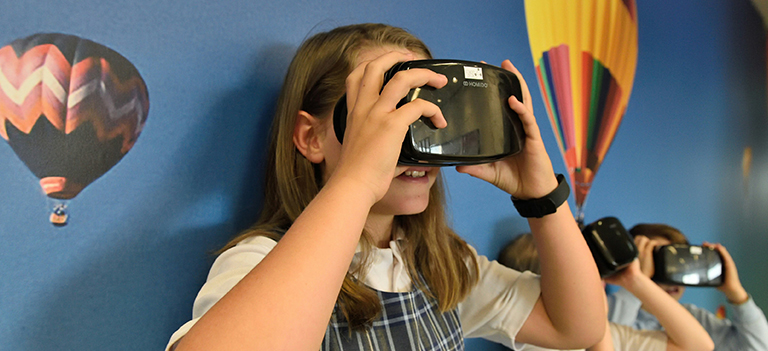
    A student holds up a phone. On the screen, a machine appears right on the table in front of her. She turns it, zooms in, and looks at how each part works. Her partner leans in. They start talking.

    “What if we change this part?”

    “Can we make it faster?”

    “Wait, let’s try another idea.”

    In this classroom, ideas are no longer stuck in the mind. They are visible, movable, and shared.

    This is what happened when augmented reality was introduced into a group of students learning Design and Technology.

    Over four weeks, one group of students learned using this new tool, while another group continued with the usual method using textbooks and drawings. Both groups were given the same task: improve the design of a washing machine.

    At first, there was not much difference. In fact, some students in the traditional group even started stronger. But as the weeks passed, something began to change.

    The students using augmented reality became more active. They talked more. They tested more ideas. They were not afraid to try something different, because they could quickly adjust and see the result.

    By the end of the study, their work told the story.

    They did not just come up with more ideas. They explored different types of ideas. More importantly, they developed their designs in greater detail. Their sketches were richer, their explanations clearer, and their thinking more refined.

    What made the difference was not just the technology itself.

    It was what the technology allowed them to do.

    They could see what they were thinking. They could build on each other’s ideas. They could experiment without worrying about making mistakes. Learning became something they did together, not alone.

    Still, this does not mean technology can replace good teaching.

    Without guidance, even the best tools can fall flat. The real value of augmented reality comes when it is used to support discussion, exploration, and collaboration.

    There are also limits to what this study can say. It was done in one school, over a short period of time. Different students, different settings, or longer use might lead to different results.

    But one thing is clear.

    When students can see their ideas come alive, they begin to think differently.

    And sometimes, that is where creativity begins.

  • Blending Faith and Tech: Can Tech Support Spiritual Habits?

    Blending Faith and Tech: Can Tech Support Spiritual Habits?

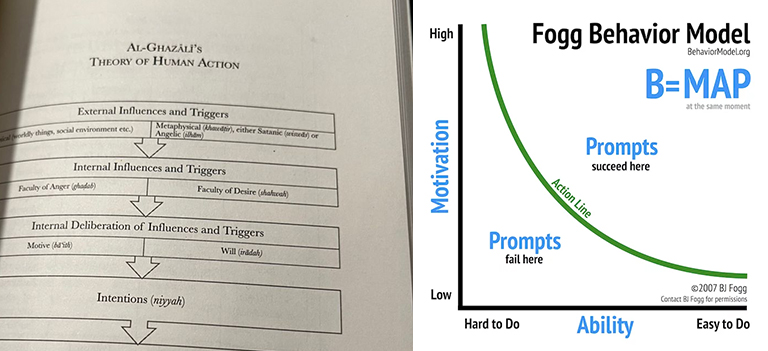
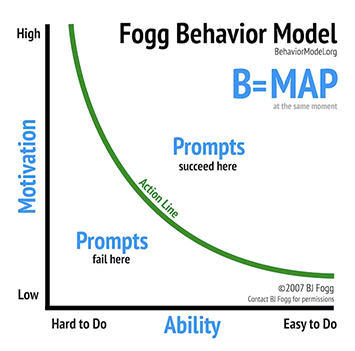
    Today has been quite busy writing a research proposal that needs to be submitted next week. While going through my old proposals, I came across one submitted last year. In short, this proposal attempted to integrate a behavior change model and a persuasive design model into “context-aware” technological features to encourage congregational prayer. It was my first attempt at exploring the religious domain.

    The reviewer’s comments on this proposal were quite interesting and raised many new questions. The emergence of these questions is not necessarily a bad thing, on the contrary, it is a blessing for a researcher.

    One of the comments stated:

    “The researcher should seek advice from religious scholars. Can this method be used? To what extent can it be applied? In my view, the act of performing prayer stems from faith (iman). If faith is weak, one will forget. If faith is strong, no matter how busy, one will prioritize it. Is the context aware and persuasive method appropriate in this case?”

    This comment indeed has a valid basis.

    The suitability of behavior change frameworks or any other theories of a secular nature that separate religious, spiritual, and metaphysical elements is questionable when implemented in technology aimed at encouraging religious practices of a spiritual nature, such as prayer.

    There are already research domains and concepts that attempt to integrate technology with religion, such as “Digital Religion” and “Technomoral.” Several Western universities have even established dedicated research centers for this domain:https://www.technomoralfutures.uk/

    Much work and research have been conducted there on the philosophy of technology and ethics. However, when discussing philosophy and ethics, these areas are closely tied to worldviews. Naturally, studies applying a Western secular worldview will be framed as “universal” and referenced by subsequent researchers.

    But what about Islam?

    Returning to that proposal, several questions arise:

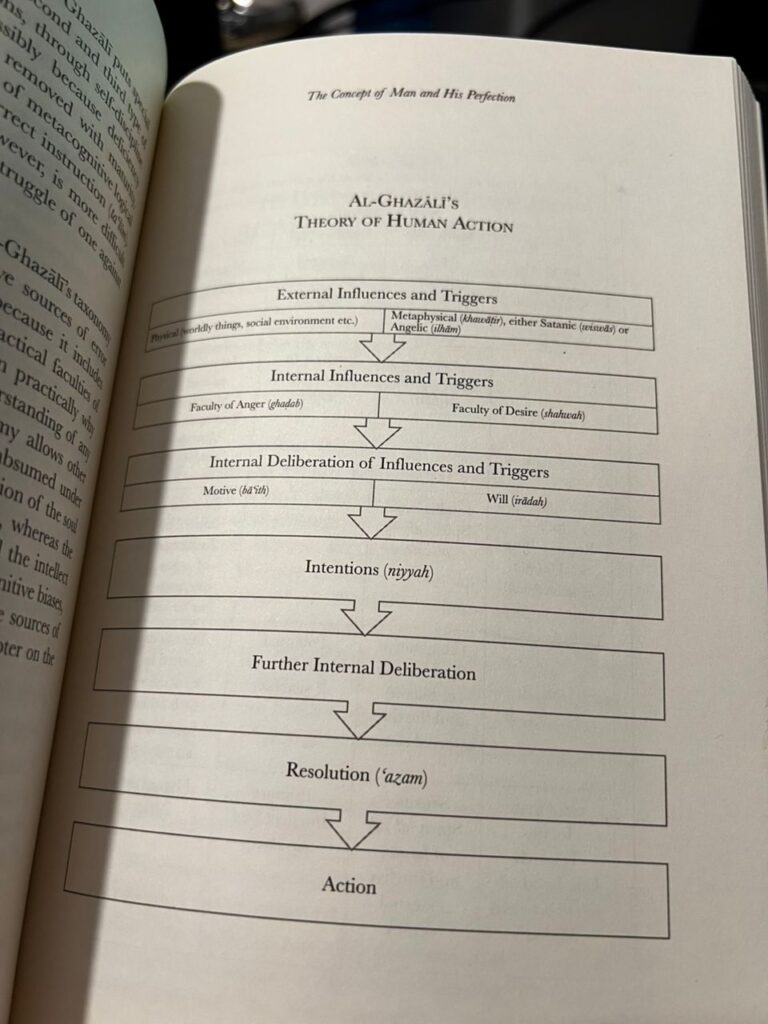
    • How can behavior change frameworks or other theories based on religion, such as Al Ghazali’s Theory of Human Action, which involves spiritual and metaphysical elements, be translated into technology design?

    In the Islamic context, integrating technology into the religious domain requires deep scrutiny because it involves matters of Islamic rulings (ahkam), spirituality, and metaphysics, not merely outward actions. One possible approach at this early stage is to develop a technology design framework grounded in the Quran and Hadith, aligned with the maqasid al shariah. For example, the Hadith in which the Prophet ﷺ advised that when visiting someone’s home, one should greet (give salam) and ask permission up to three times; if permission is not granted to enter, one should leave. Could such a hadith on visitation etiquette be translated into a notification feature, for instance? (Of course, this would require consultation with religious scholars and experts.)

    If such a framework could be translated into technological features, another question arises:

    • How, and with what indicators, can we measure the effectiveness of such technology in strengthening spiritually oriented practices according to the religious understanding?

    In research, determining these success or effectiveness indicators is crucial for assessing whether the hypothesis has been achieved. This is especially true in technical fields such as information technology, where research typically emphasizes empirical evidence. Yet no technology can measure sin, reward (pahala), sincerity, and so on.

    If spiritual and metaphysical indicators are excluded, then how would Islamic technology differ from other secular technologies? Does the concept of Islamization of technology exist?

    Answering these questions requires exploring and engaging with many other branches of knowledge, including religious sciences such as tafsir, hadith, and fiqh, as well as fields like the philosophy of Islamic science and epistemology, to explore the Islamic worldview and thought framework.

    References:

  • Persuasive Design: Helping Seniors Eat Healthier with a Mobile App

    Persuasive Design: Helping Seniors Eat Healthier with a Mobile App

    *This post summarizes the paper titled Mobile Application on Healthy Diet for Elderly based on Persuasive Design. Click here to read: DOI

    Eating well is crucial to maintaining good health, especially as we age. However, many elderly people struggle to keep track of their meals or determine what is good for them. This study introduces Nutrihealth, a mobile app created to help elderly users manage their diets using persuasive design techniques.

    Nutrihealth is a mobile app that helps seniors

    • Calculate their Body Mass Index (BMI)
    • Track their daily calorie intake
    • Get food suggestions based on their needs

    But what makes Nutrihealth special is how it’s designed to encourage users to stay healthy, not just inform them. That’s where persuasive design comes in.

    Persuasive design is a way of designing technology that gently guides people to make better choices without forcing them. It uses strategies that motivate and influence behavior.

    Nutrihealth uses these techniques:

    • Reduction: simplifies tasks to make them easier to do
    • Tunneling: guides users step by step
    • Tailoring: gives personalized suggestions
    • Self-monitoring: shows users their progress
    • Attractiveness: uses a clean, senior-friendly interface
    • Trustworthiness: provides reliable and clear information
    • Readability & terminology: uses simple language and clear visuals

    These elements help seniors stay engaged, understand the app easily, and feel motivated to improve their diet. As people age, they may face challenges like memory issues, lower tech confidence, or reduced eyesight. Persuasive design helps by :

    • Making technology more approachable
    • Encouraging positive habits without feeling overwhelmed
    • Giving feedback that builds confidence and motivation

    In short, it turns an app into a gentle coach instead of just a tool. Nine seniors in Malaysia, aged 50 and above, used the app for three days. They logged their meals, got daily calorie updates, and received food suggestions. Afterward, they answered a survey and were interviewed.

    • Easy to use: Most said the app was simple and not confusing
    • Helpful info: It gave useful feedback about their health
    • Family support: Their families encouraged them to use it
    • Willing to continue: All were open to using it again in the future

    Some faced technical issues like older phones or limited food options in the app’s database, but the overall experience was positive.

    Nutrihealth shows that with thoughtful, persuasive design, mobile apps can truly support older adults in living healthier lives. The app didn’t just inform. It inspired users to take action. With more development, like a larger food database and wider testing, Nutrihealth could become a valuable tool for elderly care everywhere.